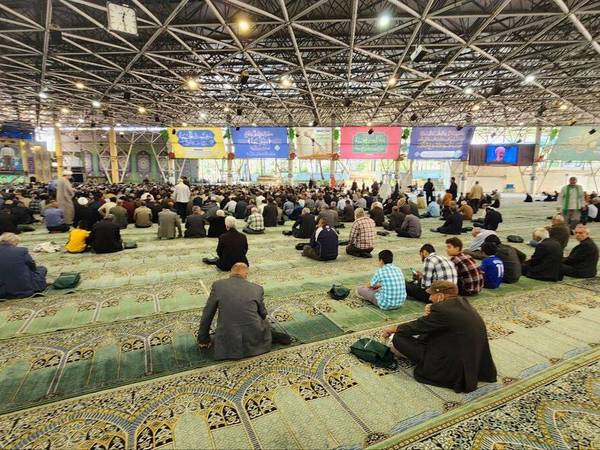
Despite millions of dollars in state funding and tight clerical oversight, most of Iran’s mosques sit half-empty, and Friday prayers have dwindled as a platform for religious and political messaging.
The Center for the Supervision of Mosque Affairs, a branch of the Organization for Islamic Propagation, oversees and coordinates mosque activities.
Prayer leaders in major mosques are appointed or vetted by provincial representatives of the Supreme Leader, while smaller neighborhood mosques may select imams locally—though clerical approval is still required.
Mosques also serve as mobilization hubs, with Basij units of the Revolutionary Guards frequently operating from them. This dual religious–military role shapes both administration and staffing.
No fewer than 24 institutions—from the Leader’s provincial offices and Basij units to the Endowment and Charity Affairs Organization (ECAO) and municipal authorities—play a direct or indirect role in mosque management.
Yet despite extensive resources, many remain underutilized.
Reza Moamami-Moghaddam of the ECAO has acknowledged that of Iran’s 85,000 mosques, only about 2,750 are highly active, around 20,000 host regular religious or cultural activities, and more than 16,000 are almost or completely inactive.
Low turnout in daily and weekly prayers reflects broader cultural shifts.
Senior cleric Mohammad Ali Ayazi complained in 2016 that in one city only 0.2 percent of the population attended Friday prayers, a decline that has eroded mosques’ role as community and mobilization centers.
Through the Friday Prayer Headquarters, the Leader’s office appoints and supervises Friday Imams, vets sermon content, and sets policy guidelines on political, social, and religious themes.
Sermons routinely stress resistance to foreign adversaries, support for domestic policies, and the ideals of the Islamic Revolution.
Friday Imams in provincial capitals wield particular influence, often outranking local governors as the Leader’s representatives. Their messaging is closely monitored to ensure complete alignment with state priorities, making Friday prayers a central instrument of official propaganda.
Funding comes from state budgets, imam salaries, provincial grants, mosque endowments (waqf) such as rental property and commercial assets, and local donations. Transparency is limited, with detailed expenditure reports rarely published.
Recent budgets earmarked trillions of rials for mosque and Friday prayer programs.
The Center for the Supervision of Mosque Affairs received 3.7 trillion rial ($3.7 million), the Headquarters for the Promotion of Prayer $2 million, the Friday Prayer Leaders Policy-Making Council $3.1 million, and the Friday Prayer Headquarters nearly $3 million.
These funds cover salaries, cultural programs, and construction projects, yet little is disclosed about how they are actually spent.