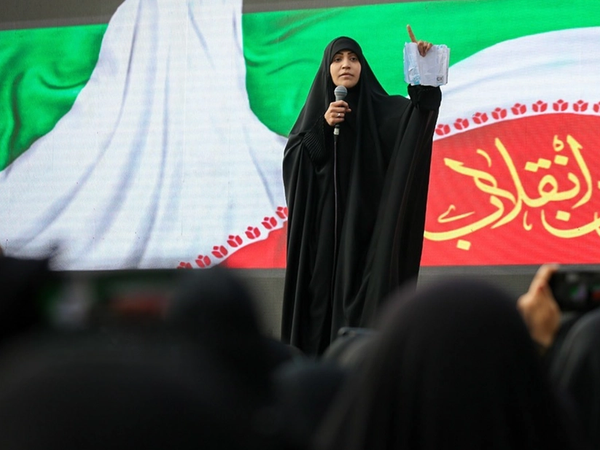
Tehran may be poised to carry out a politically explosive crackdown on Islamic veiling after Supreme Leader Ali Khamenei issued a directive to step up enforcement according to a leaked directive.
An audio file surfaced online in which senior cleric Hossein Rafiei asserted that Khamenei had instructed the government to step up enforcement of the Islamic dress code on Iranian women.
Official scrutiny of women's dress had eased in the year's since the death of a young woman, Mahsa Amini, sparked nationwide protests in 2022 which were violently suppressed.
The laxness had appeared to reach new levels following a 12-day war with Israel and the United States in June, as authorities appeared keen not to stoke public anger.
Rafiei said Khamenei issued the written order after reviewing an intelligence ministry report completed three months after the conflict. The precise timing was not clear.
Several cabinet members, he alleged, had initially objected but President Masoud Pezeshkian “insisted on abiding by the order.”
One of the ministers, the head of the Government Information Counci Elias Hazrati later confirmed the directive but denied any cabinet dispute.
The president and ministers, he said, oppose “coercive methods such as the morality patrols” that have often “worsened the situation.”
Hardline mobilization
Hardline factions seized on the revelation as a mandate to intensify pressure on women.
They quickly organized a social campaign for a November 28 march, coinciding with the traditional death anniversary of Fatima, the Prophet Mohammed’s daughter.
“The Leader’s remarks on the report … have shaken officials,” lawmaker Ghasem Ravanbakhsh said at an event in Tehran on Friday.
“(Khamenei) emphasized in his message that supervisory bodies are obliged to identify and take action against organizers and agents responsible for the problems that have arisen regarding hijab and chastity.”
‘Government’s obligation’
The conservative daily Khorasan, aligned with Speaker Mohammad-Bagher Ghalibaf, bashed Hazrati for implying that Iran’s leadership was divided on the issue.
Khamenei’s directive, the editorial asserted, was an “explicit directive” for decisive action against those who disrupt public and social order, invoking a criminal offense under Iranian law.
The paper warned that “the slightest misunderstanding … or conflation of ‘enforcement’ with ‘tension’ could once again pave the way for a repeat of bitter past experiences.”
Khamenei’s reserved position
Khamenei had refrained from explicitly addressing the hijab issue in public for a year, but on November 3 urged women to “remind” those around them of its religious significance.
His last major intervention before that was in April 2023, when he accused foreign intelligence services of encouraging hijab defiance and called such acts “religiously and politically haram (forbidden).”
It remains unclear when Khamenei reviewed the intelligence report or issued his directive, but the leak reframes several recent official comments.
On November 18, during a Cultural Revolution Council meeting, Pezeshkian said adherence to hijab norms “should begin from within government bodies,” not through coercion or confrontation.
On August 30, he had warned that strict enforcement could “create conflict in society” and spark tensions the government may be unable to contain.
‘Enemy tools’
A string of recent cultural events in Tehran has drawn backlash after videos showed participants ignoring hijab rules.
Tehran Design Week, held at the University of Tehran’s Fine Arts campus, was shut down earlier this month after a Basij student protest accused the venue of becoming a site for “inappropriate entertainment.” The Basij is a domestic enforcement militia.
Since August, at least 20 cafes, restaurants and wedding halls have been closed nationwide for alleged violations ranging from “serving alcohol” to “nudity” and “mixed-gender dancing,” according to the reformist daily Ham Mihan.
Recent reports also indicate expanding non-coercive enforcement tools, including digital and administrative controls such as disabling SIM cards of violators and heightened scrutiny of celebrities and influencers who openly reject the hijab.
Chief Justice Gholamhossein Mohseni-Ejei has described the undermining of the veil as among the “enemy’s tools” and warned that event organizers—as well as authorities issuing permits—could be prosecuted as accomplices if violations occur under their watch.