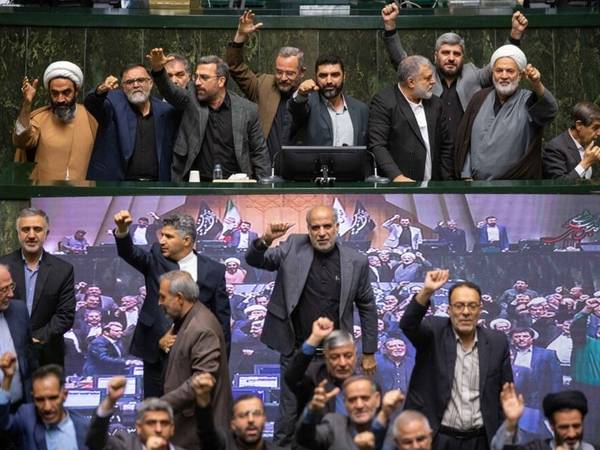
Iran’s fractious parliament is the crosshairs of increasingly strident criticism as factional infighting has precluded any concerted response to a deepening economic and ecological crisis.
Tehran media marked Parliament Day on Monday not with praise but with pointed attacks on lawmakers and the institution itself.
The centrist Ham Mihan called the Majles an example of “institutional backwardness,” arguing that the body has undergone “too many negative changes” compared even to the first post-revolutionary parliament.
Moderate outlet Khabar Online highlighted what it described as lawmakers’ exclusive perks, even as they fail to advance legislation that addresses worsening economic hardship as the rial plumbed new lows against the dollar this week.
The institution that Iran’s first Supreme Leader Ruhollah Khomeini, once branded “above all else” has seen its role steadily diminished—at times bypassed altogether, such as when Supreme Leader Ali Khamenei tasked the heads of the three branches with drafting the annual budget.
‘Indifferent to public’
Ham Mihan noted that today’s Majles bears little resemblance to the institution defined in the Constitution, accusing lawmakers of corruption and poor judgment for pursuing restrictions on personal freedoms rather than alleviating public distress.
Former lawmaker Mahmoud Abbas Zadeh Meshkini told Khabar Online that MPs enjoy government-funded vehicles and special traffic lanes in Tehran, while many or their relatives sit on the boards of major companies.
He accused lawmakers of ignoring the plight of ordinary Iranians and argued that the Majles is no longer capable of overseeing government performance.
Another former lawmaker, Moineddin Saeedi, said legislators have grown indifferent to public concerns, consumed instead by factional disputes and personal gain.
Addressing the broader infighting, Saeedi said: “The people do not care about these matters and find the constant fight between reformists and conservatives laughable.”
Factional interests
The parliament has been the central platform for attacking Iran’s moderates in the past year, with the administration of Masoud Pezeshkian getting the most heat.
Lawmakers—led by Speaker Mohammad Bagher Ghalibaf, who lost the 2024 presidential race to Pezeshkian—have repeatedly summoned ministers, launched probes and used floor debates to chip away at the government’s credibility.
Last week, the establishment daily, Ettela’at, criticized MPs for spending more time attacking the administration and prominent moderates—former Foreign Minister Javad Zarif and former President Hassan Rouhani—than on substantive legislation.
Even the conservative Jomhouri Eslami weighed in against the legislature on Monday, blaming Iran’s Guardian Council for what it described as a biased vetting process that undermines genuine representation.
Many sitting MPs won their seats with under 5 percent of eligible votes in low-turnout elections in March and May 2024.