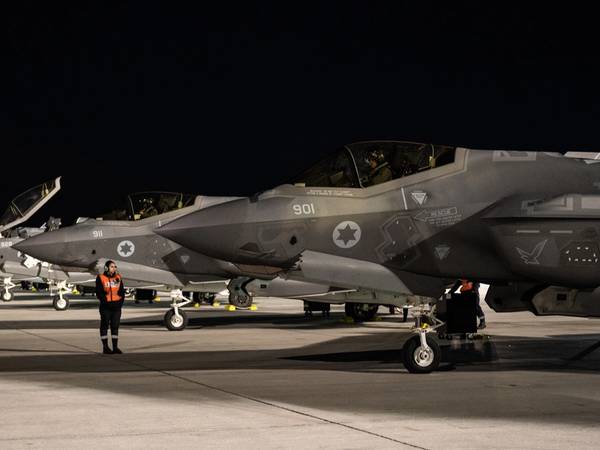
Israel's quarrel with Iran will end either with a full scale war including a ground invasion or through talks, ex-air force chief Major General Eitan Ben Eliyahu said in an interview with the 103fm radio station on Thursday.
A 12-day Israeli military campaign in June which was capped off with US strikes on Iranian nuclear facilities, he said, had damaged but not finished off Iran's capabilities.
"Perhaps if there is a certain weakness in our attack, it is that we did not eliminate the nuclear program, but we did delay it for many years to come," he said.
"Now either you decide on a total war with Iran, including a ground invasion," he added, "or you go for economic pressure alongside attempts to return to negotiations."
Ben Eliyahu did not specify if he meant Israel or the United States.
Iran and the United States held five rounds of indirect talks in April and May. A sixth was tentatively scheduled for the beginning of June but never occurred as Israel launched its surprise campaign beginning on June 13.
The strikes killed senior nuclear scientists along with hundreds of military personnel and civilians. Iranian counterattacks killed 32 Israeli civilians and an off-duty soldier.
Joining the conflict, the United States attacked three Iranian nuclear sites and Iran responded with missile attacks on a US airbase in Qatar before US President Donald Trump enforced a ceasefire.
Downside of US strikes
Tehran, Ben Eliyahu added, had drawn insight on Israel's defenses in the war and might position itself to wreak greater damage in another conflict.
"At the time, we taught the Iranians what they needed to improve for next time: the number of missiles, the accuracy of the missiles, moving the entire array further east and south, the surprise of these weapons, the depth of dispersion," he said.
Ben Eliyahu lamented that the US strikes, while advancing Israeli war aims, may have deprived Washington of its credibility as a mediator to solve the standoff peacefully.
"The Americans participated in the attack in the 12-Day War. Their participation was essential and effective, but there was also a negative side to it."
"As soon as the Americans participated in the attack, they lost their strength and status as those responsible for the negotiations on the political side, as such a mediator and coordinator. They lost legitimacy, this is a very important thing."
US President Donald Trump and Israeli Prime Minister Benjamin Netanyahu discussed regional issues including Iran on Monday, according to a CNN report, as Israeli defense officials warned that a renewed conflict was possible.