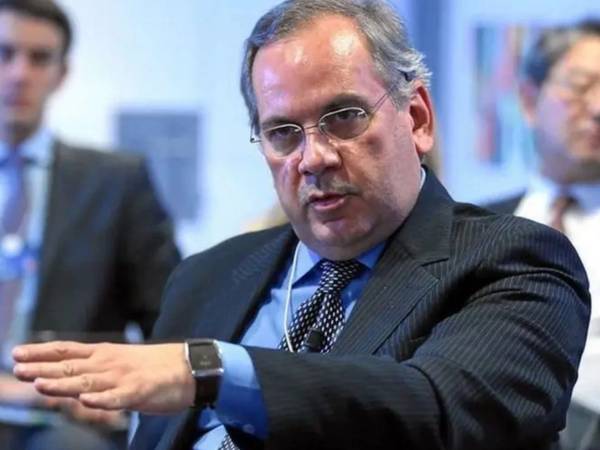
A prominent academic’s assertion that many of Iran’s problems stem from “the dominance of the economically weak class” in governance has stoked outrage in a country whose theocracy bills itself as a champion of the downtrodden.
In a recent interview, Mahmood Sariolghalam, a US-educated professor of international relations at Tehran’s Shahid Beheshti University, argued that senior positions should not be held by individuals from the country’s lower economic strata.
“No one from the lower economic strata should be allowed to become foreign minister or finance minister,” he said, adding that such posts require the “expertise and rational capacity of the mind.”
Sariolghalam, who held senior roles at the Center for Scientific Research and Middle East Strategic Studies under presidents Mohammad Khatami and Hassan Rouhani, framed the remarks as an analysis of development patterns rather than a social judgment.
Critics from across the spectrum accused him of class discrimination, delegitimizing the political agency of Iran’s poor and promoting an elitist technocratic worldview.
But others were more sympathetic as many observers have questioned Tehran's management of deepening diplomatic, economic and resource challenges.
For decades since the 1979 Islamic Revolution, positions of authority from local officials to the presidency have often been filled by loyal cadres often drawn from poorer demographics.
Under pressure, Sariolghalam told the reformist Ensaf News his remarks had been distorted, insisting he had highlighted the developmental role of the middle class, not the poor.
“The middle class matters not only in financial terms but also for its intellectual, educational, and investment-oriented capacities,” he said, citing Japan as an example of middle-class resilience.
‘Oligarchy’
Experts have cited the dangers of sanctions and economic mismanagement to Iran's middle class, which economists and political scientists often view as a key source of dynamism in society.
International academics Mohammad Reza Farzanegan and Nader Habibi published research in the European Journal of Political Economy in which they said sanctions on Iran had decimated the middle class and the political benefits it could bring.
"The sanctions regime on Iran was far from being a surgical strike; instead, it was a sledgehammer that smashed the very group that represents the best hope for a more moderate and stable future," they wrote in an editorial on Al-Jazeera.
In a front-page editorial titled “The Savior Class,” the centrist daily Sazandegi defended Sariolghalam's tack.
“The emphasis on the ‘middle class’ … is not meant to suggest economic superiority,” it wrote, but to underline the need for “security, mental order and relief from livelihood pressures” for sound decision-making.
The paper argued he was criticizing systems that allow “individuals who lack intellectual, managerial, or mental qualifications” into key posts.
A group of academics echoed that defense, arguing governance failures stem from the rise of opportunistic figures who wield power to “compensate for their own life shortcomings.”
Hardline outlets reacted fiercely. Several accused Sariolghalam of equating poverty with “mental deficiency” and advocating a “technocratic oligarchy” at odds with the Islamic Republic’s valorization of the mostaz’afin — often translated as “the dispossessed.”
“The downtrodden and the barefooted are expected to endure a bleak fate… while the aristocrats and the affluent… sit upon their backs and rule over them,” the IRGC-linked Javan proclaimed.
State to blame
Conservative daily Khorasan accused Sariolghalam of shifting blame for failed engagement with the West onto the “lower classes.”
Conservative media also tied the remarks to former president Hassan Rouhani, casting them as part of broader ideological failings among Iran’s technocratic current.
“The mind behind Rouhani’s thinking,” as Mehr News branded Sariolghalam, had exposed “one of the deepest intellectual flaws” of Iran’s centrists: that only they know how to run a country.
Some moderate voices pointed out that the ferocity of the debate revealed deeper structural problems.
Journalist Ahmad Zeidabadi argued in Ham-Mihan that Tehran’s decades-long, excessive rhetorical defense of the poor had created conditions in which “Sariolghalam’s repulsive statement has somehow gained acceptance.”