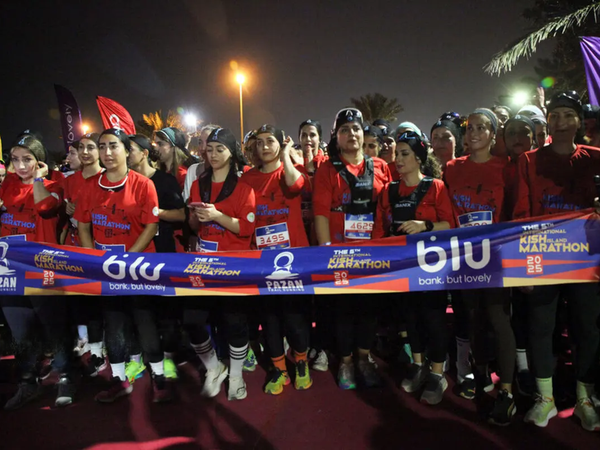
The political storm over a marathon on Iran’s Kish Island may have started as a dispute over unveiled participants, but it now reflects a deeper struggle between a society pushing for change and institutions intent on reasserting control.
The sixth Kish Marathon was held on Friday morning with nearly 5,000 runners on the Persian Gulf resort island, including hundreds of unveiled women, despite opposition from Iran’s Athletics Federation which had cited concerns over “legal and religious requirements.”
Hardline factions swiftly framed the event as an assault on Islamic values. Outlets like the Revolutionary Guard-linked Tasnim News Agency accused organizers of deliberately encouraging moral decay, and a local prosecutor confirmed the arrest of a regional official and an organizer.
“This is no longer negligence; the relevant officials must be immediately punished… The Kish Marathon … has turned into a symbol of promoting and advertising licentiousness,” Tasnim wrote.
Ultra-hardliners repeated this framing across social media. Some described the event as “an organized move to promote corruption and widespread uncovering of hair.”
One user, Mehran Karimi, argued in a post on X that “the priority… must be to confront the roots of promoting corruption and prevent the repetition of such a disgrace.”
Ultra-hardliner lawmaker Ali Shirinzad called the marathon a deliberate provocation: “Holding a women's marathon without hijab is a nose-thumbing of the legal and religious principles of the Islamic Republic,” he posted on X.
Much of the criticism has directly targeted President Masoud Pezeshkian’s government, accusing it of enabling hijab violations. One ultra-hardliner wrote on X: “The government has become the main supporter of this organized indecency.”
Double standards exposed
Critics of the crackdown argue that the outrage is selective. Moderate website Rouydad24 highlighted a virtually identical event held at Tehran's Ravagh Mall, where women also participated without full hijab.
“No cries of outrage were raised… Why? Because Ravagh operates under the supervision of a senior state official’s son. Therefore, there is no reprimand whatsoever.”
The report initially identified the senior state official as Ali Asghar Hejazi, the deputy chief of staff to Supreme Leader Ali Khamenei, but later removed his name from the article.
Social media users also shared images of similar marathons held in 2021 and 2023 under former hardline president Ebrahim Raisi—events that violated hijab rules yet went unchallenged.
“The zealots must explain the difference… they remained silent about the first one and declared the second one a crime!” conservative journalist Reza Mansournia remarked on X.
Even the conservative Khorasan newspaper, aligned with Parliament Speaker Mohammad-Bagher Ghalibaf, warned that the backlash had gone too far, arguing it could harm tourism and the local economy
“Such incidents could not only overshadow a positive event like the Kish Marathon but also cause tensions that are currently not in the interest of national cohesion.”
A crisis the crackdown can't solve
Supreme Leader Ali Khamenei’s recent directive to Pezeshkian’s government, urging tougher enforcement of hijab laws, has fueled fears of a renewed crackdown. Yet even pro-Ghalibaf journalists warn that harsh measures are counterproductive.
Ali Gholhaki wrote that past crackdowns only “amplified the harm several times over,” adding: “Yet now we long for the hijab situation of 10 years ago!”
Former Rouhani-era official Roohallah Jomei contrasted the thousands who joined the Kish marathon with the handful of vigilantes camped outside parliament earlier this year demanding stricter hijab enforcement.
“They couldn't get a hundred people to join them, but more than five thousand went to Kish… Iran will not return to the time before the fall of 2022!” he posted on X.
Moderate politician Sina Kamalkhani added: “The likelihood that the hijab situation will return to what it was before is as much as the likelihood that the dollar (now over 120,000 tomans to the dollar) will return to 3,000 tomans (a few years ago).”
The feminist group Enghelab-e Zanane (Women Revolution), in a statement released on social media, called the arrests evidence of the state’s inability to contain growing public defiance: “The government neither intends to retreat nor is capable of fully enforcing repression; therefore, any free presence of women becomes a security crisis for it.”