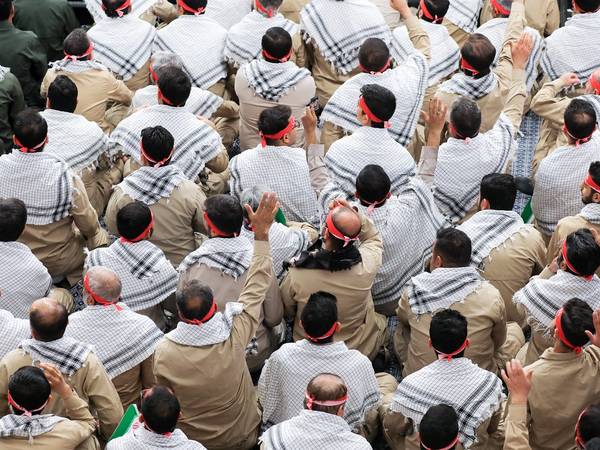
At an official ceremony in Supreme Leader Ali Khamenei's compound on Thursday, a religious official chanted to congregants that US President Donald Trump's death was nigh and that Iran would vanquish Israel.
Mehdi Rasouli, a well-known maddah or religious eulogist and chant leader, performed at the Imam Khomeini Hussainiyah in Tehran. It is the main auditorium within Khamenei's office complex known as Beyt-e Rahbari or the Leader's house.
“From now on, we have one goal — and that is the heart of Tel Aviv,” he said. "Your accursed name will no longer remain in this world. Tell that yellow-haired murderer he will be no more," he said in reference to Donald Trump to loud assent from attendees.
The event held earlier this week formed part of ceremonies marking Basij Day, when Iran’s volunteer paramilitary force is feted.
Eulogists in Iran's Shi'ite Muslim tradition deploy chants and poetry to encourage enthusiasm in religious gatherings. Since the 1979 Islamic Revolution which ushered in a theocracy, the content of their presentations reflect state political ideology.
"Bullies stronger than you lie buried under piles of earth," Rasouli continued. "You will not see Iran’s surrender even in your dreams ... Are you too, like Pharaoh, thinking you will not die?"
"Death does not hesitate even a moment to take your soul. It wouldn’t hurt to visit the graves of Carter and Reagan once in a while," he said.
Crowd reactions followed the familiar arc of such performances – chants at crescendos, brief laughter at lines like “If you mention the name of Iran, be polite,” and tears as Rasouli invoked recent war dead, including Revolutionary Guard commanders killed in clashes with Israel.
He delivered the poem in epic, martial cadences, and the audience periodically answered with slogans.
The recital ended with pledges of allegiance to the Supreme Leader, prompting the hall to respond “Labbayk, labbayk” – an Arabic formula of assent meaning “at your service” in a show of allegiance to Khamenei.
A poem of menace and myth
A maddah is a lay performer, not a cleric. Over three decades, their role has expanded from mourning rites to emotionally charged performances that can carry political overtones.
Their verses, set to strong rhythms, aim to stir grief for the martyrs of Karbala, devotion to the Prophet’s family, and, increasingly, political zeal.
When delivered at the leader’s own venue, the rhetoric carries extra weight for loyalists – even as officials can argue that maddahs speak for themselves, not for the state.
Rasouli’s text stitched together recurring motifs. He opened by hailing Iranian resilience and vowing ultimate triumph – “In the end, Iran will be the victor of the battle” – before pivoting to taunts of US and Israeli leaders.
At another point he warned: “Ajal does not delay in taking your soul,” using the Persian term ajal – the appointed time of death – to suggest that fate, or the Angel of Death, does not pause, a standard rhetorical device in Persian oratory.
The poem drew on classical Persian epic and Shi'ite sacred history.
Rasouli invoked Rostam, the pre-Islamic epic hero of Ferdowsi’s Shahnameh, likening Israel to a div (demon) and rhyming “div” with “Aviv” to fix the poem’s “final aim on the heart of Tel Aviv.”
He also reached for Shi'ite iconography, saying Ali, the first Shi'ite Imam, would come for Israel with his bifurcated sword Zolfaghar, a symbol widely recognized in Iran.
The barbs sat alongside appeals to faith and fidelity: victory, he said, hinges on obedience to the Supreme Leader – a cue for synchronized chants of “Labayk.”
Modern military references appeared in the poem too. In a couplet that played on rhyme and Iranian missiles, Rasouli said: “If you have bunker-busters, we have Kheibar-Shekan,” pairing the Persian for “bunker-breaker” (sangar-shekan) with Kheibar-Shekan (Khaybar-Breaker), the name of an Iranian solid-fuel medium-range ballistic missile unveiled in 2022.
Khaybar also refers to a 7th-century Jewish oasis near Medina and, in Shi'ite lore, to Imam Ali’s breaching of its fort – a religious touchstone repurposed in modern rhetoric.
Why eulogists matter
Under Ali Khamenei, maddahs regularly perform at his residence on major religious occasions and enjoy networks of patronage that can extend through state and quasi-state institutions.
Analysts say eulogists act as emotional amplifiers: knitting mourning, nationalism and loyalty into a single ritual package.
Within pro-government circles, however, the venue and proximity to power matter; when a poem is staged at the leader’s inner sanctum, supporters treat it as consonant with the leadership’s mood, if not a formal policy.
The eulogist scene is diverse, spanning apolitical performers, staunch loyalists to the leadership, and figures tied to rival conservative factions.
Celebrity maddahs have campaigned for candidates, criticized senior officials, and at times helped mobilize crowds.
Their hey’ats (religious associations) fund and stage mass ceremonies during Muharram and Arbaeen, and some maintain close ties with the Revolutionary Guards’ Basij militia.
There are at least 150,000 maddahs in Iran now some of whom receive “astronomical” sums as “gifts” for their much-advertised performances.
In a genre long fused with piety and politics, Rasouli leaned into a newer twist: Persian epic motifs spliced onto Shi'ite heroism – a form once anchored almost entirely in Shi'ite themes.
Shahnameh references now sit alongside invocations of Ali and the “martyrs,” recasting loss and defiance in a national-myth frame.
Inside the hall, the result is part sermon, part rally, part catharsis.