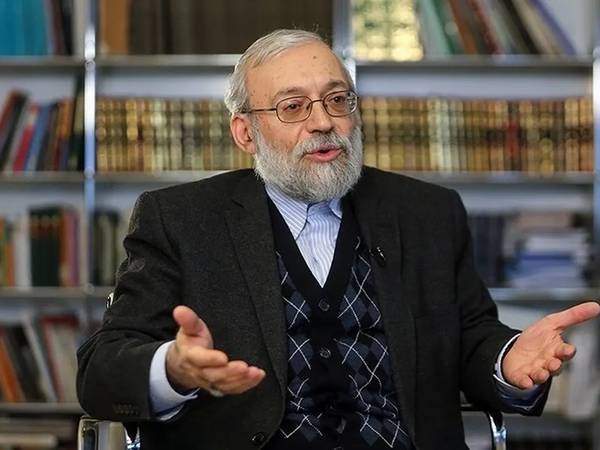
Former Iranian official Mohammad‑Javad Larijani said his country has developed a new theoretical doctrine: one in which a state capable of building a nuclear bomb in under two weeks chooses not to do so.
He pointed out that the fatwa by Supreme Leader Ali Khamenei against nuclear weapons has strong Shia jurisprudential foundations.
Larijani, a former senior judiciary official who also served as a top adviser to the Supreme Leader, added that he supports the expansion of Iran’s nuclear capabilities, framing them as a deterrent and emphasizing the country’s decision not to weaponize.
He also voiced sharp criticism of the 2015 nuclear deal, saying the so-called “diplomacy doctrine” of the Joint Comprehensive Plan of Action (JCPOA) had led Iran to “distress and reversed courage.”
Larijani, speaking at a conference examining the thoughts of Ali Khamenei, said that the JCPOA doctrine -- based on trading rights for concessions -- was akin to surrendering part of Iran’s rights in order to preserve others, and he invoked Iran’s war-era ethos of resisting aggressors.
Larijani’s comments reflect a nuanced position often heard from Tehran: while Iran signals that it remains technically close to nuclear weapon capability, it continues to assert that its policy remains peaceful and that the decision not to build such weapons stands.
The remarks come amid international scrutiny of Iran’s nuclear program, where questions remain over enrichment levels and stockpiles, and where the authenticity and legal force of Khamenei’s so-called fatwa have been contested by analysts.
International experts say the Iranian stance complicates diplomatic efforts, as Tehran’s acknowledgement of capability but insistence on conditional restraint leaves room for ambiguity.
Critics argue this could be designed to serve both as deterrence and diplomatic leverage.